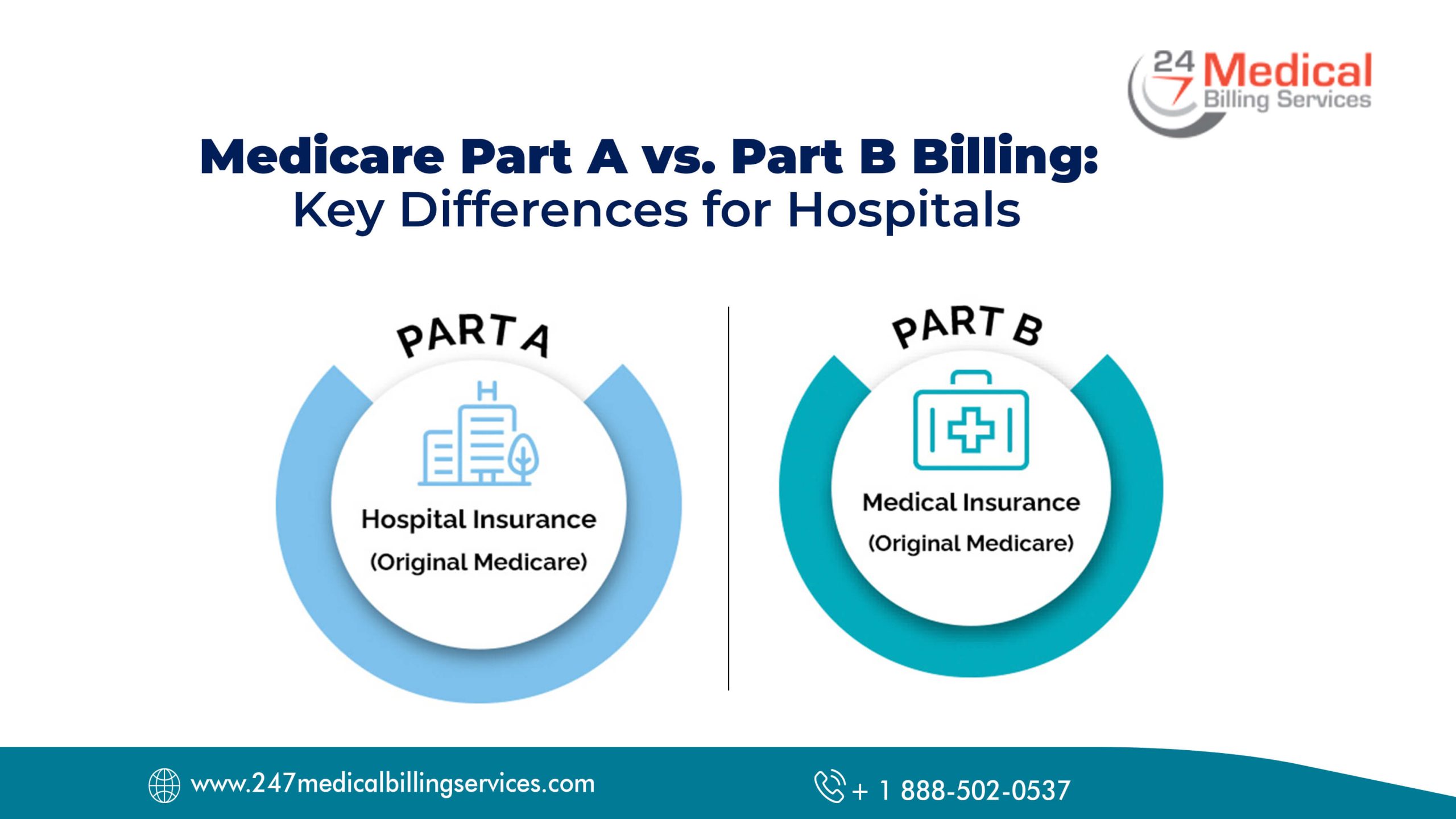
Medicare pays hospitals through two very different doors. Part A funds the inpatient stay, skilled nursing and hospice, and pays the facility one bundled amount for the admission. Part B funds physician work, outpatient department services, observation, therapy and equipment, and pays per service. A hospital touches both on the same patient, often on the same day, and the boundary decides the claim form, the payment system, what the patient owes and whether the claim survives audit.
This is the definitive guide to Medicare Part A vs. Part B billing from the hospital's side of the desk. It sets out what each part covers, how institutional and professional claims are built, the status decisions that move a stay from one part to the other, the cost-sharing rules behind patient balances, and the errors that most often send hospital claims back unpaid.
What Part A and Part B cover in the hospital setting
Part A is hospital insurance in the literal sense. It pays for inpatient admissions, inpatient rehabilitation and psychiatric stays, skilled nursing facility care after a qualifying inpatient stay, hospice and a limited amount of home health.
Part B is medical insurance. It covers physician and practitioner services wherever they are delivered, hospital outpatient department visits, emergency department care that does not end in admission, observation, diagnostic imaging and laboratory work, outpatient therapy, durable medical equipment and a defined set of preventive services. A few patients decline Part B, which matters when physician charges are billed.
| Feature | Medicare Part A | Medicare Part B |
|---|---|---|
| Nature of coverage | Hospital insurance: inpatient, SNF, hospice, limited home health | Medical insurance: physician, outpatient, observation, DME, preventive |
| Claim format | Institutional claim on the UB-04 / 837I | Professional claim on the CMS-1500 / 837P; institutional outpatient on the UB-04 |
| Payment method | Prospective payment per stay (MS-DRG for acute hospitals) | Fee schedule per service; outpatient department services under OPPS |
| Patient cost sharing | Deductible per benefit period, daily coinsurance after day sixty | Annual deductible, then a fixed coinsurance share of the approved amount |
| Who bills | The facility | The facility for outpatient services; the practitioner for professional services |
How hospital claims differ under each part
Hospitals produce two streams of claims, and the difference between them is where the distinction between physician billing and hospital billing lives.
The institutional claim under Part A
An inpatient admission generates one institutional claim covering the stay from admission through discharge. It carries revenue codes by department, principal and secondary diagnoses, procedures and discharge disposition. The Medicare contractor groups the claim into a diagnosis-related group and pays a single amount regardless of length of stay or services consumed, so accuracy depends on documentation and clinical coding rather than itemized supplies.
The professional claim under Part B
Every physician, hospitalist, surgeon, anesthesiologist and radiologist who treats the same inpatient bills separately on a professional claim paid under the physician fee schedule. The beneficiary owes Part B cost sharing on those charges even while the facility charges fall under Part A. Employed physicians bill through the hospital's group; independent physicians bill under their own enrollment.
The outpatient facility claim under Part B
When a patient is treated in the emergency department, observation, an outpatient clinic or same-day surgery, the hospital bills a facility claim under Part B. Those services are paid through the outpatient prospective payment system, which packages many items into ambulatory payment classifications. Device-intensive procedures and pass-through items follow their own packaging rules, explained in Decoding Device Billing under OPPS for Hospitals.
Status decisions that move a stay between Part A and Part B
The same patient in the same bed can be a Part A inpatient or a Part B outpatient depending on a single order, and that order changes the hospital's revenue, the patient's liability and the audit risk.
Under the two-midnight benchmark, inpatient admission is generally appropriate when the admitting physician expects the patient to need hospital care spanning at least two midnights, or when the procedure appears on the inpatient-only list. Shorter expected stays belong in outpatient observation under Part B.
Two correction paths exist. If the hospital discovers before discharge that an inpatient order was not supported, utilization review can change the status to outpatient using the condition code designated for that purpose, provided the physician concurs and the patient is notified. If a Part A claim is denied after payment because the admission was not reasonable and necessary, the hospital may rebill the covered services under Part B within timely filing limits.
Cost sharing, benefit periods and what the hospital collects
Part A works in benefit periods. A benefit period begins on the day of inpatient admission and ends once the patient has gone sixty consecutive days without inpatient hospital or skilled nursing care. Each benefit period carries its own deductible, which covers the first sixty inpatient days in full. Days sixty-one through ninety carry a daily coinsurance, and beyond ninety days the patient draws on a lifetime reserve of sixty additional days at a higher daily amount. Skilled nursing coverage requires a qualifying inpatient stay of at least three consecutive days, one more reason observation status has consequences beyond the hospital.
Part B is simpler but touches far more claims. The patient meets a single annual deductible, then owes a fixed coinsurance share of the Medicare-approved amount for most services, including the professional charges billed during an inpatient stay and every outpatient facility visit. Supplemental coverage, Medicaid or a Medicare Advantage plan can shift these balances, so eligibility verification must confirm which parts the patient holds and which payer is primary.
Common Part A vs. Part B billing errors in hospitals
Most hospital Medicare denials trace back to a few avoidable errors at the boundary between the two parts:
- Billing an inpatient stay that does not meet the two-midnight expectation, then losing the admission on medical review instead of rebilling under Part B.
- Submitting a professional claim whose place of service or dates conflict with the facility claim for the same encounter.
- Failing to verify that a Part A patient also holds Part B, leaving physician charges uncollectable.
- Counting observation days toward the skilled nursing qualifying stay.
Fixing these requires facility and professional billing teams to share one view of the encounter. How Hospital Medical Billing Works: A Complete Overview walks through that workflow; Hospital Revenue Cycle: Trends in Billing and Collection Services covers how hospitals organize the work, and a coordinated revenue cycle management function closes the gap between the two claim streams.
What this means for hospital practices
For a hospital, Medicare Part A and Part B are not two payers but two rulebooks applied to one patient. Every encounter needs a defensible status decision, a facility claim built to the right payment system, a professional claim that agrees with it, and an eligibility record confirming which parts the patient holds. Where different departments own those pieces, claims fall into the seams. Hospitals that unify utilization review, coding and billing, or engage specialized hospital billing services to do so, see fewer status denials, faster payment on both claim types and fewer surprised patients at the statement stage.
Frequently asked questions
Can a hospital bill Part A and Part B for the same patient?
Yes, and it usually does. The facility bills the inpatient stay under Part A, while each treating physician bills professional services for the same admission under Part B. The two claims must agree on dates, diagnoses and patient status, because the Medicare contractor cross-checks them and denies conflicts.
What happens when an inpatient claim is denied as not medically necessary?
The hospital may rebill the services that would have been covered as outpatient under Part B, provided the rebilled claim is filed within the timely filing window measured from the original date of service. The patient becomes responsible for Part B cost sharing, and the hospital must issue any required notices.
Does observation status count toward the skilled nursing qualifying stay?
No. Only days as a formal inpatient count toward the three-consecutive-day qualifying stay that unlocks Part A skilled nursing coverage. Time in observation, the emergency department or outpatient surgery is Part B time, which is the main reason patients must receive written notice when observation lasts more than a day.
Why do physician and hospital claims use different forms?
Institutional providers report on the UB-04 or its electronic equivalent because Medicare pays them through prospective payment systems built on revenue codes and diagnosis grouping. Practitioners report on the CMS-1500 or its electronic equivalent because they are paid per service under the physician fee schedule.
Ready to get your Part A and Part B claims paid the first time?
24/7 Medical Billing Services has been managing revenue cycles since 2005, delivering a ~99% first-pass clean-claim rate, days in A/R under 25 and denials down by up to 40% for hospital clients, with claims scrubbed and filed within 24 hours. You get a dedicated account manager, a free 360° reporting dashboard and HIPAA- and SOC 2-compliant operations. Request a complimentary review of your Medicare claims and find out where revenue is slipping between the parts.
Get Your Free Hospital Billing Audit · +1 888-502-0537 · sales@247medicalbillingservices.com