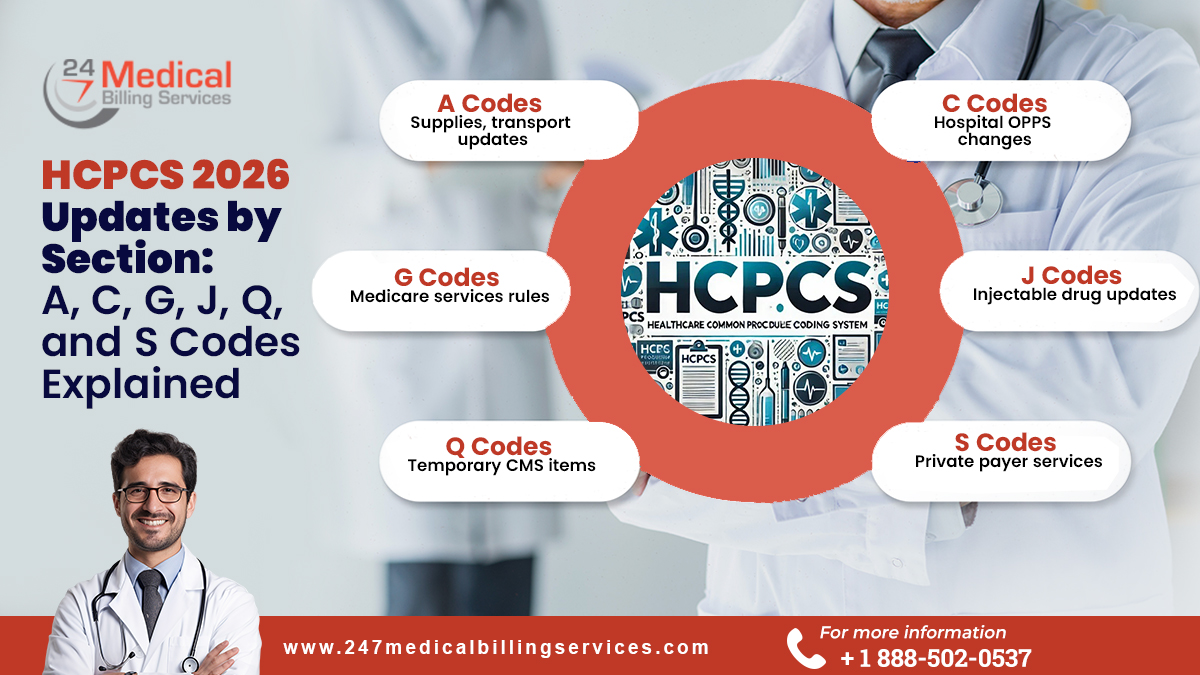
Did you know that the HCPCS 2026 update introduces 160 new codes, removes 101 existing codes, and revises nearly 300 descriptors, all effective January 1, 2026? These numbers show how significantly HCPCS Level II coding continues to evolve. As healthcare services expand across outpatient, behavioral health, remote care, and advanced drug therapies, CMS has updated A, C, G, J, Q, and S Codes to reflect better how care is delivered and billed today.
With new codes for medical supplies, behavioral health integration, injectable drugs, biosimilars, and temporary products, even small gaps in awareness can lead to claim denials or payment delays. This blog explains the HCPCS 2026 updates by section to help you understand where changes occurred and how to prepare your billing processes for a smooth transition into the new coding year.
A Codes — Medical and Surgical Supplies
A Codes primarily apply to items such as catheters and other disposable supplies used across outpatient, home health, and supplier settings. In the 2026 updates, CMS refined A Codes to improve product-level clarity, reporting accuracy, and reimbursement alignment, particularly for intermittent urinary catheter supplies.
-
New A Codes Introduced in 2026
The 2026 HCPCS update introduces three new A Codes to better distinguish hydrophilic intermittent urinary catheters based on design and included components. These additions reduce reliance on broad, generic coding and allow claims to reflect the exact product provided.
-
Straight Tip Hydrophilic Catheters
A4295 is used for intermittent urinary catheters with a straight tip and a hydrophilic coating. This code supports accurate reporting for standard straight-tip designs that require reduced friction during insertion.
-
Coude Tip Hydrophilic Catheters
A4296 applies to intermittent urinary catheters with a coude (curved) tip and a hydrophilic coating. This distinction is essential for patients who require curved-tip catheters for anatomical or clinical reasons.
-
Hydrophilic Catheters With Insertion Supplies
A4297 identifies hydrophilic intermittent urinary catheters supplied with insertion-related components. This code allows bundled reporting when additional sterile supplies are included with the catheter system.
-
Revisions to Existing Catheter Codes
CMS revised the descriptors for A4351 and A4352 to clarify that these codes include catheters with or without surface coatings, such as silicone or similar materials. This update removes ambiguity around coating-related billing and ensures consistent reporting when coated and non-coated catheters fall under the same functional category.
C Codes — Hospital Outpatient PPS and Device-Specific Codes
C Codes are HCPCS Level II codes used under the Hospital Outpatient Prospective Payment System (OPPS) to report temporary devices, procedures, and drugs that do not yet have permanent CPT or HCPCS codes. In 2026, CMS updated C Codes to support new outpatient technologies and clearer device identification.
-
New C Codes Introduced in 2026
CMS added 19 new C Codes to report new medical devices and injectable products used in hospital outpatient settings.
-
Device-Specific C Codes
New codes were introduced to identify advanced implantable devices, including integrated neurostimulators. This will allow hospitals to report device usage during outpatient procedures accurately.
-
Post-Surgical Pain Management Devices
CMS added multiple new C Codes to report non-opioid medical devices used for post-surgical pain relief. As a result, this reflects the growing use of technology-based pain management alternatives.
-
Discontinued and Replaced C Codes
CMS discontinued C9305 and C9306, which were temporary drug codes. These codes were replaced with permanent J Codes that carry the same descriptors, allowing continued billing while standardizing drug reporting across care settings.
G Codes — Temporary Procedures and Professional Services
G Codes are temporary HCPCS Level II codes used to report services not described by CPT, particularly those related to care coordination, behavioral health, and remote services. The 2026 updates expand G Codes to reflect team-based care and digital service delivery.
-
New Behavioral Health Integration G Codes
CMS added G0568 through G0570 to support psychiatric collaborative care management. These codes allow reporting of structured behavioral health integration activities, including care coordination, psychiatric consultation, and ongoing patient monitoring.
-
New Remote Evaluation and Management G Codes
CMS introduced G0660 through G0668 for team-based remote evaluation and management services. These codes align with established E/M levels and allow providers to report remote clinical services performed by coordinated care teams.
-
New Procedure-Specific G Code
A new G Code was added to report intraoperative nerve cryoablation for post-surgical pain management, recognizing this emerging technique as a separately reportable service.
J Codes — Drugs Administered Other Than Oral Method
J Codes are used to report injectable and non-oral drugs, including biologics and specialty medications. The 2026 updates include new drug-specific codes, crosswalk replacements, and deletions of discontinued products.
-
New J Codes Added in 2026
CMS added multiple new J Codes to separately identify drugs that are newly approved or not therapeutically equivalent to existing products. These updates enable more precise drug identification and reduce the need for miscellaneous coding.
Several new J Codes were also created to replace discontinued C and S Codes, ensuring uninterrupted Medicare billing for products permanently classified as drugs.
-
Deleted J Codes
CMS removed numerous J Codes for drugs that are no longer active, discontinued, or no longer payable. These deletions help prevent outdated billing and reduce claim submission errors.
-
Route of Administration Modifiers
CMS continues to require the use of modifier JA for intravenous administration and modifier JB for subcutaneous administration to ensure correct payment for J Codes that do not specify a route of administration.
Q Codes — Temporary Codes for Drugs and Biological Products
Q Codes are temporary HCPCS Level II codes used to report biosimilars, skin substitutes, and certain biological products while CMS evaluates long-term coverage and payment policies. In 2026, CMS expanded Q Codes to improve product-level reporting.
-
New Q Codes Introduced in 2026
CMS added 25 new Q Codes, including those for brand-name biosimilars and multiple skin-substitute products. These additions allow providers to report specific products rather than using generic or unclassified codes, improving billing accuracy and product tracking.
Several new Q Codes also support reporting of human cell, tissue, and cellular- or tissue-based products commonly used in wound care and outpatient treatment settings.
S Codes — Temporary National Codes (Non-Medicare)
S Codes are temporary national codes primarily used by non-Medicare payers to report supplies and services that lack permanent HCPCS codes. Though Medicare generally does not reimburse S Codes, CMS updates them when products transition to Medicare-recognized coding.
-
Deleted S Codes and Crosswalks in 2026
CMS discontinued select S Codes that were crosswalked to newly created J Codes. This change allows those products to be billed consistently under Medicare-recognized drug codes rather than temporary non-Medicare classifications.
Moreover, other S Codes were deleted entirely when the associated products or services were no longer active or applicable.
Conclusion
The HCPCS 2026 updates across A, C, G, J, Q, and S Codes highlight CMS’s continued focus on clearer reporting and more accurate reimbursement. In fact, these changes simplify the identification of supplies, services, and drugs. Also, such updates support newer care models such as behavioral health integration, remote services, and advanced therapies. As a result, providers must ensure their coding practices and billing systems are fully aligned before the January 1, 2026, effective date.
At the same time, keeping up with frequent code changes can be challenging for in-house teams. Therefore, many practices choose to outsource their billing to 24/7 Medical Billing Services to manage updates efficiently and reduce administrative pressure. With dedicated coding expertise and ongoing monitoring of HCPCS changes, outsourcing helps minimize errors, prevent denials, and maintain steady revenue.
FAQs
Are HCPCS code changes retroactive?
The 2026 HCPCS updates apply only to services provided on or after January 1, 2026.
Are deleted HCPCS codes still payable under any circumstances?
Deleted codes are no longer payable once they become inactive.
Do HCPCS updates impact modifiers?
Some HCPCS changes require careful modifier use to ensure correct payment and claim acceptance.