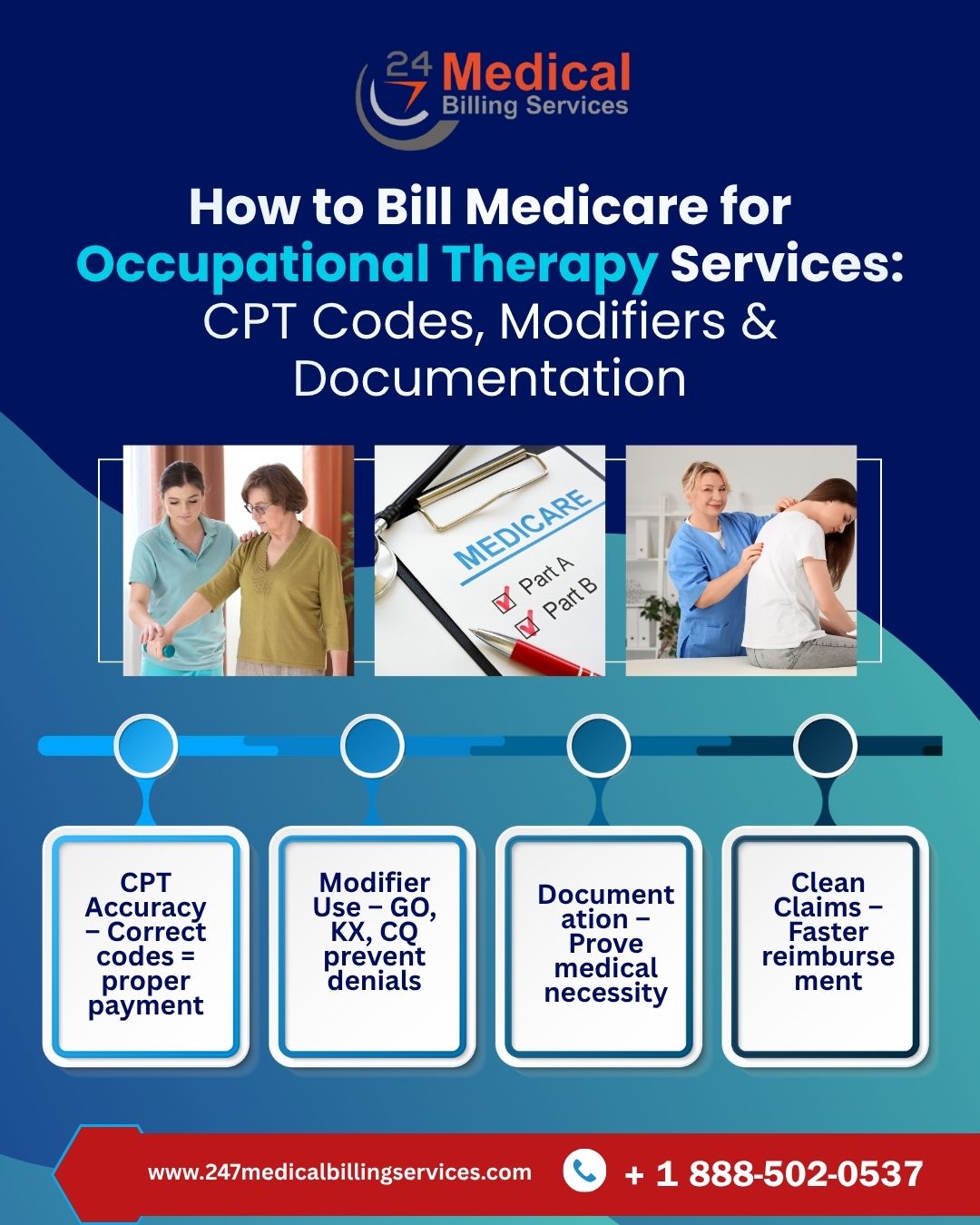
Did you know that improper documentation and coding errors contribute to a significant share of Medicare claim denials, costing healthcare providers billions annually?
As Medicare requirements continue to evolve, providers must follow a more structured and detail-focused billing approach. This means ensuring that every service is clearly supported, accurately recorded, and aligned with current guidelines. A well-managed billing process not only reduces errors but also strengthens financial performance and workflow consistency.
In this blog, we will break down how to bill Medicare for occupational therapy services, covering CPT codes, modifiers, and documentation to help you improve accuracy and confidence in your billing process.
Step-by-Step Process to Bill Medicare for Occupational Therapy Services
Billing Medicare for occupational therapy services requires a structured approach to ensure accuracy and compliance. In fact, each step plays an important role in proper claim submission and reimbursement. Therefore, following a clear process helps providers reduce errors, maintain consistency, and ensure that all services are billed according to Medicare guidelines.
Step 1: Verify Patient Eligibility and Benefits
Before initiating therapy, providers must confirm Medicare eligibility and available therapy benefits. This includes:
- Check Part B active status
- Verifying deductible status
- Review therapy threshold balance
- Identify need for ABN if required
As a result, providers can plan services appropriately and avoid unexpected denials due to coverage limitations or exceeded benefit caps.
Step 2: Conduct Evaluation and Select CPT Codes
The initial evaluation determines the patient’s functional limitations and guides treatment planning. As a result, providers must select the correct CPT code based on complexity levels, such as:
97165for low complexity97166for moderate complexity97167for high complexity
Therefore, accurate code selection ensures proper billing and reflects clinical decision-making aligned with patient-specific therapy needs.
Step 3: Use Accurate CPT Codes for Interventions
Each therapy session must be billed using CPT codes that match the services delivered. These include:
97110for therapeutic exercise97112for neuromuscular re-education97530for therapeutic activities97535for self-care training
As a result, accurate coding ensures claims reflect actual treatment provided and supports proper reimbursement under Medicare guidelines.
Step 4: Apply the 8-Minute Rule
Medicare applies the 8-minute rule to calculate billable units for timed therapy services. Providers must combine total treatment minutes across codes. It is calculated as follows:
- 8–22 minutes equals 1 unit
- 23–37 minutes equals 2 units
Therefore, precise time tracking ensures correct unit calculation and prevents underbilling or overbilling that could affect reimbursement accuracy.
Step 5: Apply Mandatory Modifiers
Modifiers provide essential details about therapy services and must be used correctly on claims. These identifiers clarify service type, provider involvement, and coverage conditions. Such modifiers are:
- GP or GO for therapy plan
- CO for OTA involvement
- KX for services beyond threshold
- GA when ABN is issued
As a result, proper modifier usage ensures accurate claim processing and reduces the risk of denials or payment adjustments.
Step 6: Develop a Plan of Care
A plan of care outlines treatment goals, frequency, and duration of therapy services. It must be established after evaluation and certified within the required timeframe. Therefore, having a structured plan ensures services are medically necessary and aligned with Medicare coverage requirements.
Step 7: Maintain Proper Documentation
Documentation must clearly demonstrate skilled therapy services and patient progress. Providers should include treatment details, clinical reasoning, and measurable outcomes. As a result, complete documentation supports medical necessity and ensures compliance during audits or claim reviews.
Step 8: Submit Claims and Monitor Payments
After services are delivered, claims must be submitted accurately with correct codes and modifiers. Providers should track claim status and address any issues promptly. Therefore, active monitoring helps reduce delays, resolve denials efficiently, and maintain steady reimbursement flow.
Key Medicare Billing Guidelines for Occupational Therapy
It is essential to understand Medicare billing guidelines for ensuring compliance and avoiding costly errors. These guidelines provide specific instructions on how therapy services should be billed and documented. Therefore, following these rules helps providers maintain accuracy, improve claim acceptance rates, and support smooth reimbursement processes.
-
Evaluation and Testing Restrictions
Medicare restricts billing evaluation codes with certain physical performance tests on the same day when services overlap. Providers must ensure that procedures are distinct and medically necessary. Therefore, careful coordination of services and accurate coding helps prevent duplication, reduces claim denials, and supports proper reimbursement.
-
Advance Beneficiary Notice (ABN) Usage
An Advance Beneficiary Notice must be issued before providing services that may not be covered by Medicare. This allows patients to make informed decisions regarding potential out-of-pocket costs. Therefore, proper documentation of ABN use protects providers from liability and ensures transparency in billing practices.
-
Therapy Threshold and KX Modifier
Medicare sets an annual therapy threshold, after which continued services require additional justification. The KX modifier is used to confirm that services remain medically necessary beyond this limit. Therefore, detailed documentation is essential to support ongoing treatment and ensure uninterrupted reimbursement for extended therapy services.
-
Progress Report Requirements
Medicare requires providers to submit progress reports at least every tenth treatment visit to demonstrate patient improvement. These reports must include measurable outcomes and updated goals. Therefore, timely and accurate reporting helps maintain compliance and supports continued coverage for therapy services under Medicare guidelines.
-
Skilled Therapy Requirement
Medicare only covers services that require the expertise of a qualified occupational therapist. Providers must clearly document the complexity of care and clinical decision-making involved. Therefore, demonstrating that services cannot be performed by untrained individuals is essential to justify coverage and avoid claim denials.
-
Plan of Care Certification Timeline
The plan of care must be established after evaluation and certified by a physician or qualified provider within thirty days. In fact, delays in certification can affect claim approval. Therefore, timely review and authorization ensure compliance with Medicare requirements and support consistent reimbursement for therapy services.
-
Medical Necessity and Reasonableness Standard
Medicare requires that all occupational therapy services must be reasonable and necessary for diagnosis or treatment. Providers must justify the frequency, duration, and type of therapy. Therefore, aligning treatment plans with patient condition and expected outcomes helps ensure compliance and supports successful claim approvals.
-
Supervision Requirements for OTA Services
Services provided by an Occupational Therapy Assistant must meet Medicare supervision guidelines. The supervising therapist must be involved in care planning and oversight. Therefore, proper supervision documentation is essential to ensure compliance and correct application of modifiers such as CO for assistant involvement.
-
Correct Use of Therapy Discipline Modifiers
Medicare requires discipline-specific modifiers to identify the type of therapy provided. In fact, the GO modifier is used on all applicable claims for occupational therapy. Therefore, correct modifier usage ensures that services are categorized properly and prevents claim processing errors or reimbursement delays.
Outsourcing Occupational Therapy Billing and Coding Services
Outsourcing occupational therapy billing to experienced providers such as 24/7 Medical Billing Services can help ensure accurate coding, proper modifier usage, and complete documentation. Therefore, it supports compliance with Medicare guidelines while reducing administrative burden and improving overall billing efficiency.
Additionally, outsourcing partners provide ongoing monitoring of billing performance, timely claim submissions, and proactive denial management. As a result, healthcare providers can improve cash flow and reduce errors without overloading internal teams. This approach also ensures that billing processes remain consistent, compliant, and aligned with evolving Medicare requirements.
FAQs
Is it important to track billing trends regularly?
Tracking trends helps identify patterns that can improve billing accuracy and efficiency.
Is it beneficial to standardize billing procedures?
Standardized processes ensure consistency and reduce the risk of mistakes.
Can reporting tools support better billing decisions?
Detailed reports help improve financial planning and operational performance.