How can healthcare providers bill telehealth correctly in 2026 when the smallest coding detail can affect whether a claim is paid or denied?
What happens when the choice between POS 02 and POS 10 results in completely different reimbursement outcomes, even though the service itself remains the same?
Why does Modifier 95 still create confusion among practices trying to follow Medicare rules while also meeting the expectations of commercial payers?
These questions reflect the challenges many providers face as telehealth continues to evolve. As a result, understanding how these three elements work together is now essential for accurate billing, clean claims, and predictable payments. This blog explores each one clearly so medical practices can navigate telehealth billing with confidence and avoid costly errors.
POS 02 vs. POS 10 & Modifier 95
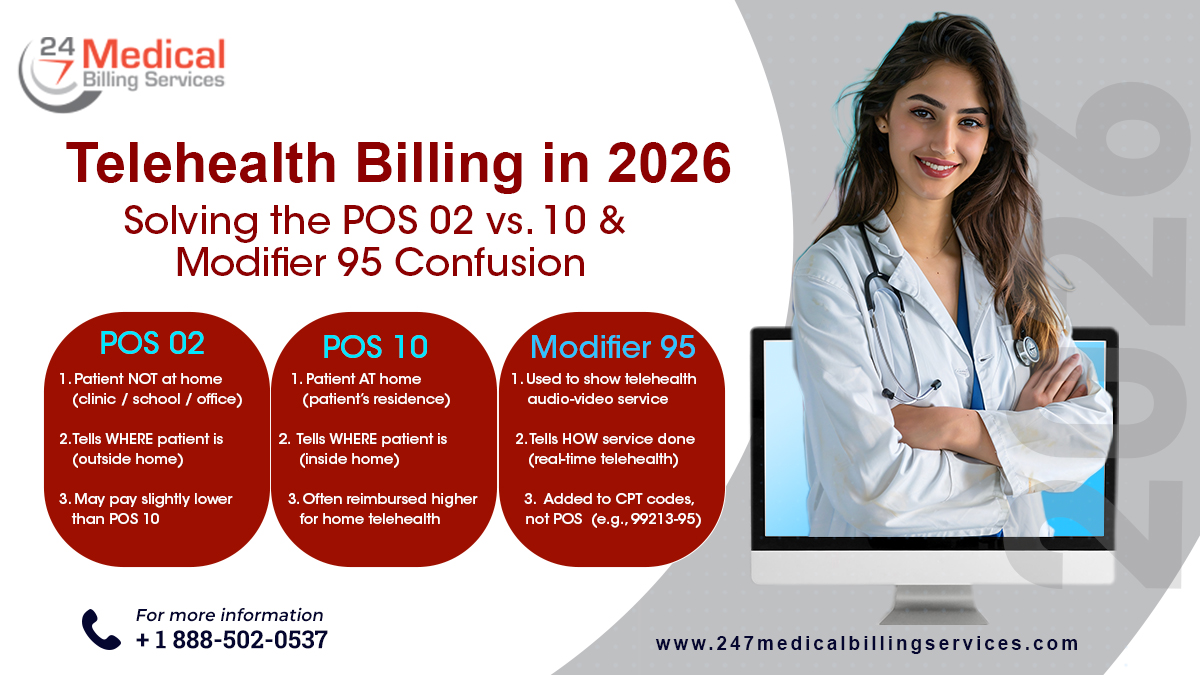
POS 02, POS 10, and Modifier 95 are essential for telehealth billing in 2026. POS codes indicate the patient's location, and Modifier 95 identifies how the service was delivered. As a result, the correct application ensures proper reimbursement and prevents claim denials.
-
Meaning
POS 02 indicates that a telehealth service occurred when the patient was not at home such as a clinic, office, or skilled nursing facility. It identifies the environment and supports accurate classification for payer review.
POS 10 indicates that the patient is receiving telehealth care from home. This includes permanent or temporary residences. It ensures accurate coding and aligns with reimbursement policies for home-based virtual visits.
Modifier 95 confirms the visit was conducted using synchronous audio-video technology. It does not describe location but validates telehealth delivery. Many commercial payers require it to ensure claims meet telehealth standards and are processed correctly.
-
Primary Purpose
POS 02 serves to report the patient's off-home location during telehealth. It allows payers to distinguish between facility-based visits and home-based services to ensure the proper reimbursement structure is applied in accordance with policy requirements.
POS 10 reports that the patient is at home during the telehealth visit. It supports coding consistency and guides payers to apply non-facility rates to reflect the provider's responsibility in delivering virtual care to a residential setting.
Modifier 95 indicates the telehealth technology used. It clarifies that the service was real-time and interactive. Though it does not affect location, it ensures payers recognize the encounter as synchronous to support correct reimbursement and claim approval.
-
Reimbursement Impact
POS 02 typically triggers a facility-based payment rate which is lower than a non-facility rate. In fact, payers interpret this code as indicating services provided in a professional environment outside the home, which influences the final reimbursement amount.
POS 10 usually leads to non-facility reimbursement, equivalent to in-office rates. Providers delivering telehealth from home assume more responsibility, and the higher payment reflects the effort, resources, and regulatory requirements of home-based care.
Modifier 95 ensures the claim is recognized as a telehealth service. In fact, omitting it when required may cause denial or reduced payment. Its presence confirms that the service met payer standards for synchronous audio-video telehealth encounters.
-
Documentation Requirements
POS 02 requires documentation confirming the patient was outside the home during the telehealth session. In fact, the details include the telehealth platform, patient identification, and site type to provide the necessary evidence for compliance and audit purposes.
POS 10 requires clear documentation that the patient was at home during the encounter. Notes should reflect location verification, consent and visit details to support proper coding and align with home telehealth reimbursement requirements.
Modifier 95 requires documentation that the visit was conducted in real-time via audio-video. Providers should note that the session was synchronous, not audio-only to ensure accurate reporting and adherence to telehealth billing standards for payer review.
-
When to Use
POS 02 applies when the patient connects from a clinic, office, or non-home facility. It correctly reflects remote virtual care and is required to distinguish off-home services from home-based visits for reimbursement purposes.
POS 10 applies when the patient participates from their home. It covers routine follow-ups, chronic care and urgent assessments conducted in a residential setting to ensure alignment with payer policies for non-facility home visits.
Modifier 95 is used whenever the telehealth service is delivered using live audio-video communication. It is attached to either POS 02 or POS 10, depending on the patient’s location and payer-specific rules, to validate the claim.
-
What They Cannot Be Used For
POS 02 cannot be used for patients at home, as this can misrepresent the location and lead to claim denials or incorrect reimbursement. It is strictly reserved for non-home settings during telehealth visits.
POS 10 cannot be used for patients in clinics, offices, or other facilities, as coding it incorrectly can trigger audits or payer denials. It applies exclusively to home-based telehealth services delivered to the patient's residence.
Modifier 95 cannot be used for audio-only or asynchronous services. Audio-only visits require Modifier 93 and asynchronous interactions follow different CPT or modifier guidelines. Misusing 95 may result in claim denial or compliance issues.
-
How They Affect Claims
POS 02 signals to payers that the service occurred outside the patient’s residence. This guides payment processing, ensures correct claim classification, and differentiates telehealth from in-person facility visits in audit reviews.
POS 10 signals to payers that the patient was at home which qualifies for non-facility rates. It ensures higher reimbursement for providers while accurately documenting the residential setting of telehealth encounters.
Modifier 95 affects claim processing by validating synchronous telehealth delivery. Though it does not determine payment rates, many payers require it to recognize telehealth and avoid denials properly, and to confirm compliance with virtual visit rules.
-
Compliance and Audits
POS 02 supports compliance by accurately reporting off-home locations. In fact, auditors verify that documentation confirms the patient's presence in the facility or at a remote site to ensure correct reimbursement and compliance with telehealth rules.
POS 10 ensures compliance by documenting home-based telehealth. This protects against audits, supports appropriate non-facility reimbursement and provides that the provider aligns with federal and payer-specific telehealth policies.
Modifier 95 demonstrates compliance with technology standards. It proves the visit used live audio and video, meeting payer requirements for synchronous telehealth, and helps prevent claim denials or recoupments during audits.
-
When and How to Combine Them
POS 02 should be paired with Modifier 95 when the patient is out of the home, and the visit is synchronous audio-video. This combination clarifies both location and technology for the payer.
POS 10 should be paired with Modifier 95 for home-based audio-video visits to ensure the payer clearly understands the patient’s location and telehealth modality. Both elements are needed for accurate reimbursement.
Modifier 95 should always accompany a POS code when billing telehealth with audio-video. Using it alone does not indicate location, and combining it with the correct POS code ensures compliance and proper claim processing.
-
What Drives Their Use
POS 02 is driven by patient location outside the home. Providers must confirm the physical setting before coding to ensure claims are submitted correctly and reimbursement aligns with payer rules.
POS 10 is driven by patient location at home. Accurate identification ensures non-facility payment, correct coding, and adherence to telehealth policies governing home-based care services.
Modifier 95 is driven by telehealth technology. It must be applied when real-time audio-video is used, signaling to payers that the encounter qualifies as synchronous telehealth and meets all documentation and coding standards.
Conclusion
Outsourcing medical billing and coding is extremely helpful for providers who need to manage the detailed rules of telehealth billing, especially when working with POS 02, POS 10, and Modifier 95. A trusted partner like 24/7 Medical Billing Services makes this process easier by carefully reviewing documentation, applying the correct location codes, and ensuring every telehealth claim meets payer requirements.
Their team stays up to date on changing regulations, prevents common coding errors, and reduces the risk of denials due to incorrect telehealth reporting. Therefore, they reduce the pressure on in-house staff and help providers receive payments faster by handling verification, coding accuracy, claim submission, and follow-up. This allows clinicians to focus more on patient care and maintain a smooth, compliant, and reliable revenue flow.
FAQs
Can telehealth rules differ between primary care and specialty care?
Certain specialties have unique exceptions and billing allowances for remote care.
Do payers require proof of technology used during telehealth visits?
Some payers require proof that the service meets their telecommunications standards.
Is insurance verification necessary before telehealth appointments?
Verification ensures the patient’s plan allows telehealth coverage for the scheduled service.